
If you Owe more than $30,000 contact us for a case evaluation at 888-756-9969
contact us for a free case evaluation at (833) 428-0937
Call us (833) 428-0937

Your Best Path to SBA Debt Relief: OIC vs. Negotiated Workout

When facing the default of an SBA loan, business owners often feel a profound sense of pressure and uncertainty. Understanding your options is the first step toward reclaiming financial stability and securing lasting business debt relief. For many, the path forward involves either an SBA Offer in Compromise (OIC) or a structured loan workout. As experienced SBA loan attorney professionals, we help you carefully evaluate your situation to choose the strategy that offers the best outcome for your specific SBA debt challenge.

When facing the default of an SBA loan, business owners often feel a profound sense of pressure and uncertainty. Understanding your options is the first step toward reclaiming financial stability and securing lasting business debt relief. For many, the path forward involves either an SBA Offer in Compromise (OIC) or a structured loan workout. As experienced SBA loan attorney professionals, we help you carefully evaluate your situation to choose the strategy that offers the best outcome for your specific SBA debt challenge.

image of an offer in compromise

What is an SBA Offer in Compromise (OIC)?

An OIC is a formal settlement proposal where we ask the SBA to accept a reduced, lump-sum payment to satisfy the full debt. We typically use this option when the business has closed and the personal guarantor lacks the financial ability to repay the full amount. Our firm thoroughly prepares the complex financial package required to demonstrate a genuine inability to pay and maximize the potential debt reduction.
image of an SBA Loan

The Power of a Structured SBA Loan Workout

A negotiated loan workout is designed to make the existing SBA debt manageable for an ongoing business. This involves modifying the loan's terms, such as extending the maturity date, lowering the interest rate, or temporarily deferring payments. We often pursue this option for viable businesses that simply need breathing room due to temporary hardship. This preserves the business while providing crucial business debt relief.

image of security

The Attorney’s Role in Protecting Personal Guarantees

Nearly all SBA loans require a personal guarantee, making the debt a personal financial risk after a default. Our primary role as your SBA loan attorney is to minimize this personal liability, whether through an OIC or a workout. We provide comprehensive protection by defending against aggressive collection actions, including Treasury offsets, ensuring your family’s assets are safeguarded while resolving your SBA debt.

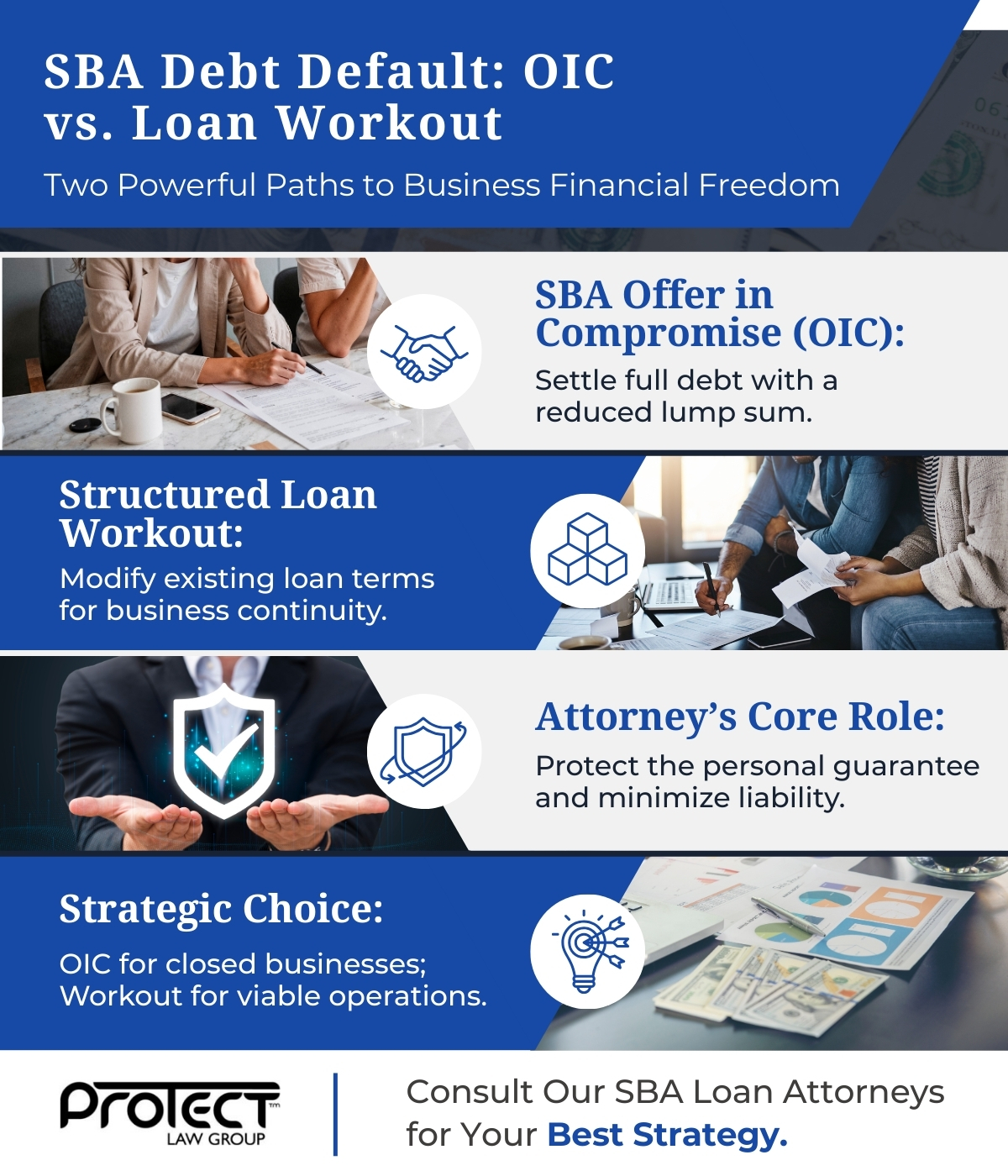
image of strategy

Choosing the Right Strategy for Your Financial Future

Selecting between an OIC and a workout is a case-by-case decision requiring deep knowledge of SBA regulations. An OIC may offer the highest percentage of business debt relief but requires a stringent financial disclosure and business closure. A workout focuses on business continuity. Our expertise lies in analyzing your unique circumstances to determine the most effective and aggressive legal path forward.

If you are struggling with overwhelming SBA debt and need expert guidance, the time to act is now. At Protect Law Group, we have a proven track record of securing favorable outcomes for business owners nationwide. We specialize in navigating the complexities of the SBA and Treasury collection processes to achieve the debt resolution you deserve. Contact us today for a consultation to explore how our SBA loan attorney team can bring you peace of mind and genuine financial freedom.

Frequently Asked Questions

Related Posts
$150,000 SBA 7A LOAN – NEGOTIATED WORKOUT AGREEMENT

$150,000 SBA 7A LOAN – NEGOTIATED WORKOUT AGREEMENT

Client’s small business obtained an SBA 7(a) loan for $150,000.  He and his wife signed personal guarantees and pledged their home as collateral. The SBA loan went into default, the term or maturity date was accelerated and demand for payment of the entire amount claimed was made.  The SBA lender’s note gave it the right to adjust the default interest rate from 7.25% to 18% per annum. The business filed for Chapter 11 bankruptcy but was dismissed after 3 years due to its inability to continue with payments under the plan. Clients wanted to file for Chapter 7 bankruptcy, which would have been a mistake as their home had significant equity to repay the SBA loan balance in full as the Trustee would likely seize and sell the home to repay the secured and unsecured creditors. However, the SBA lender opted to pursue the SBA 7(a) Guaranty and subsequently assigned the loan and the right to enforce collection to the SBA. Clients then received the SBA Official 60-Day Notice and hired the Firm to respond to it and negotiate on their behalf. Clients disputed the SBA’s alleged balance of $148,000, as several payments made to the SBA lender during the Chapter 11 reorganization were not accounted for. To challenge the SBA’s claimed debt balance, the Firm Attorneys initiated expedited discovery to obtain government records. SBA records disclosed the true amount owed was about $97,000. Moreover, because the Clients’ home had significant equity, they were not eligible for an Offer in Compromise or an immediate Release of Lien for Consideration, despite being incorrectly advised by non-attorney consulting companies that they were. Instead, our Firm Attorneys recommended a Workout of $97,000 spread over a lengthy term and a waiver of the applicable interest rate making the monthly payment affordable. After back and forth negotiations, SBA approved the Workout proposal, thereby saving the home from imminent foreclosure and reducing the Clients' liability by nearly $81,000 in incorrect principal balance, accrued interest, and statutory collection fees.

$298,000 SBA 7A LOAN - NEGOTIATED WORKOUT AGREEMENT

$298,000 SBA 7A LOAN - NEGOTIATED WORKOUT AGREEMENT

Clients obtained an SBA 7(a) loan for their small business in the amount of $298,000. They pledged their primary residence and personal guarantees as direct collateral for the loan. The business failed, the lender was paid the 7(a) guaranty money and the debt was assigned to the SBA.  Clients received the Official 60-Day Notice giving them a couple of options to resolve the debt balance directly with the SBA before referral to Treasury's Bureau of Fiscal Service. The risk of referral to Treasury would add nearly $95,000 to the SBA principal loan balance. With the default interest rate at 7.5%, the amount of money to pay toward interest was projected at $198,600. Clients hired the Firm with only 4 days left to respond to the 60-Day due process notice.  Because the clients were not eligible for an Offer in Compromise (OIC) due to the significant equity in their home and the SBA lien encumbering it, the Firm Attorneys proposed a Structured Workout to resolve the SBA debt.  After back and forth negotiations, the SBA Loan Specialist assigned to the case approved the Workout terms which prevented potential foreclosure of their home, but also saved the clients approximately $294,000 over the agreed-upon Workout term with a waiver of all contractual and statutory administrative fees, collection costs, penalties, and interest.

$430,000 SBA 7A LOAN - NEGOTIATED WORKOUT AGREEMENT

$430,000 SBA 7A LOAN - NEGOTIATED WORKOUT AGREEMENT

Clients' 7(a) loan was referred to Treasury's Bureau of Fiscal Service for enforced collection in 2015. They not only personally guaranteed the loan, but also pledged their primary residence as additional collateral.  One of the clients filed for Chapter 7 bankruptcy thinking that it would discharge the SBA 7(a) lien encumbering their home. They later discovered that they were mistakenly advised. The Firm was subsequently hired to review their case and defend against a series of collection actions. Eventually, we were able to negotiate a structured workout for $180,000 directly with the SBA, saving them approximately $250,000 (by reducing the default interest rate and removing Treasury's substantial collection fees) and from possible foreclosure.

Read more Case Results